Yarn Guitar Camera Bicycle Chess Pot Review
As a designer who spends half the day staring at stitch counts and the other half worrying about how thread tension affects fabric texture, I don’t just look for "pretty" graphics. I look for viability. When Yarn Guitar Camera Bicycle Chess Pot landed on my desk, my first instinct wasn't to admire the aesthetic—though it is charming—but to ask: does this translate well to the hoop? Can this hold up in a real-world embroidery project without losing its soul to a dense fill stitch or getting lost in a tiny corner of a tote bag?
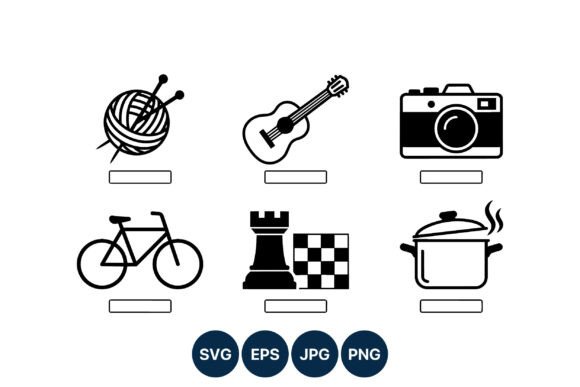
This collection of black and white vector icons depicting knitting yarn with needles, acoustic guitar, retro camera, bicycle, chess rook and board, and steaming cooking pot in simple line art style offers a unique challenge. It’s not a single monolithic design but a suite of Illustrations that function as distinct Graphics. For the modern maker, this versatility is both a blessing and a potential pitfall. Here is my practical breakdown of how these designs perform when moved from screen to stabilizer.
The First Impression: Mood and Visual Personality
The immediate appeal of Yarn Guitar Camera Bicycle Chess Pot lies in its nostalgic, analog warmth. In an era dominated by neon gradients and hyper-detailed photorealism, this simple line art style feels grounded. It evokes a specific mood: slow living, creativity, and tactile hobbies. The inclusion of the knitting yarn and cooking pot alongside the more traditional symbols like the guitar and bicycle creates a narrative of a balanced, creative life.
Visually, the shapes are clean. The acoustic guitar has a classic curve, the retro camera implies vintage photography, and the chess rook stands tall and sturdy. This clarity is crucial for embroidery. Complex, muddy lines often fail in machine work because the needle cannot distinguish between overlapping pixels. Here, the negative space is respected. The designs breathe. This suggests that when converted into an embroidery file, the resulting piece will have excellent definition, provided the digitizing is done with care.
Real-World Application: Where These Designs Shine
I tested the concept of using these icons across several common handmade product categories. The results were telling.
Custom Apparel and Sweatshirt Embroidery: Imagine a crewneck sweatshirt featuring the knitting yarn and needles paired with the acoustic guitar. This combination speaks directly to the bohemian or artistic demographic. Because the line art is simple, it works beautifully as a chest pocket placement or a small back-neck logo. It doesn’t overwhelm the garment; it adds a whisper of personality. The sweatshirt embroidery holds up particularly well here because the thick cotton blend provides enough structure to support the stitch density without pilling.
Tote Bag Design and Aprons: A canvas tote featuring the bicycle and the steaming cooking pot is a fantastic idea for a kitchen-themed brand or a lifestyle boutique. The contrast of the black thread against natural canvas makes the line art pop. Similarly, an apron embroidered with the chess rook and camera could serve as a sophisticated gift for a photographer who also enjoys strategy games. These are not just decorations; they tell a story about the wearer’s interests.
Baby Embroidery and Nursery Decor: While some of these items (like the guitar) might seem mature, the simplicity of the line art makes them adaptable. A soft baby blanket embroidered with the knitting yarn and a simplified chess pawn can be incredibly cute. The key here is scale. On a onesie or a nursery pillow cover, these icons become gentle motifs rather than bold statements. They fit perfectly into the trend of minimalist nursery decor.
Critical Considerations for the Embroidery Designer
Not every graphic translates seamlessly to thread. Here is where you need to exercise caution with Yarn Guitar Camera Bicycle Chess Pot.
- Hoop Size and Scale: These are individual icons. If you attempt to stitch one of these in a very small hoop size (under 3 inches), you risk losing detail. The curves of the guitar body or the intricate parts of the chess board may become indistinguishable blobs of thread. Always check the hoop size relative to the final product dimensions.
- Fabric Texture: Avoid using these designs on heavily textured fabrics like chunky wools or rough burlap unless you are using a heavy-duty stabilizer. The line art relies on smooth surfaces to maintain its crispness. On a stretchy fabric, such as a thin t-shirt, the running stitch used for the outlines might distort if the stabilizer isn't properly applied.
- Thread Color Contrast: The original vectors are black and white. In embroidery, this means high contrast is your friend. Dark thread on light fabric works best. However, if you try to embroider these on dark fabric using light thread, ensure the stitch width is sufficient. Thin lines can get swallowed by the fabric weave.
- Dense Stitch Areas: Be wary of the chess board squares or the camera lens details. If these are digitized as solid fills, they may create stiff, bulky spots that are uncomfortable to wear. It is often better to use a satin stitch outline or a sparse fill pattern to keep the fabric flexible.
Impact on Product Value and Brand Consistency
For the Etsy seller or small shop product owner, consistency is currency. Using a cohesive set of Graphics like this allows you to build a recognizable brand identity. If your shop specializes in "creative gifts," having a matching set of embroidery designs for guitars, cameras, and knitting supplies reinforces that niche.
Customers trust brands that look professional. A poorly digitized design looks cheap. But a well-executed version of Yarn Guitar Camera Bicycle Chess Pot elevates the perceived value of the item. It signals that the seller cares about detail. This is especially true for personalized gift markets, where the buyer is paying for uniqueness and quality presentation.
Practical Next Steps for Makers
Before you commit to a large production run, follow these steps:
- Test on Scrap Fabric: Always stitch a test sample on the exact fabric you plan to use. Check how the thread colors interact with the material.
- Review Stitch Density: Look closely at the digitizing. Are there any areas where the needle penetrates the same spot too many times? This can cause puckering.
- Check Licensing: Since this is a digital asset, confirm whether you have commercial rights to sell finished items made from these designs. This is critical for commercial embroidery projects.
- Create Printable Mockups: Before sewing, place the vector files onto mockups of tote bags, caps, and shirts. This helps you visualize the finished product and adjust placement before wasting materials.
In conclusion, Yarn Guitar Camera Bicycle Chess Pot is a versatile, mood-rich set of designs that rewards careful execution. It is not a "one-click" solution for mass production, but for the thoughtful maker, it offers endless possibilities for creating meaningful, high-quality embroidery project outcomes. Whether you are crafting a holiday embroidery gift or building a craft business around creative hobbies, these icons provide a strong visual foundation.